
If you spend five minutes on the r/Florida or r/UrbanPlanning subreddits, you’ll inevitably run into a viral thread mocking Port St. Lucie (PSL). The critiques are consistent: “It’s a city without a soul,” “It’s just a 120-square-mile residential subdivision,” and the most famous jab—“a random collection of strip malls connected by traffic jams.”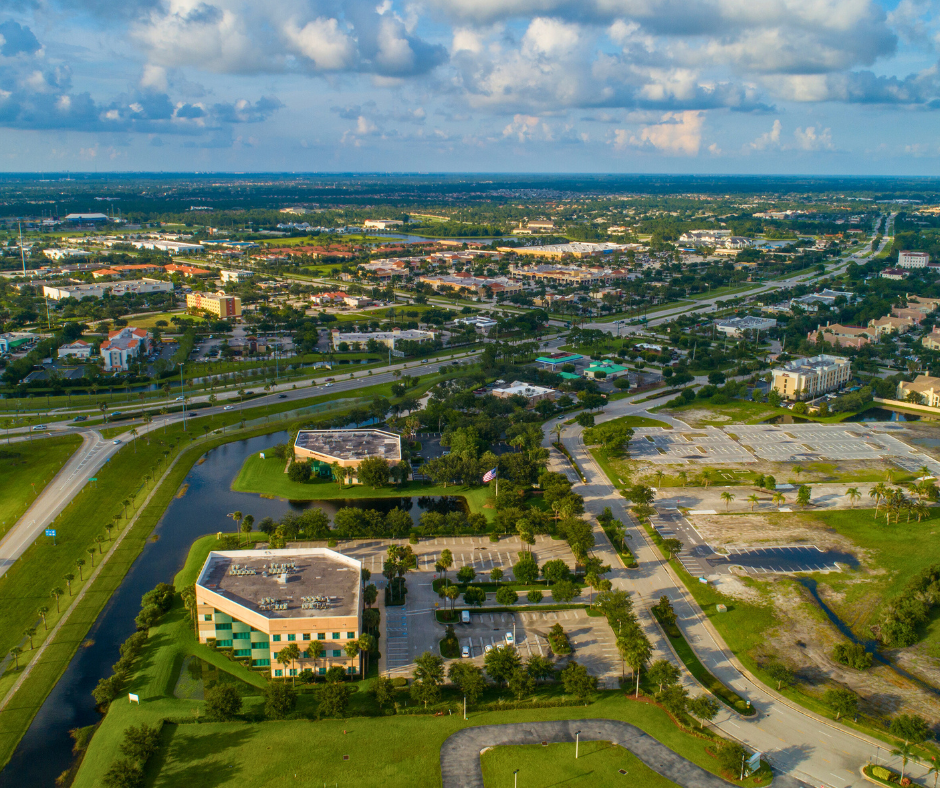
To the outside eye, the “Suburban Dystopia” label seems to stick. But as we move through 2026, the reality on the ground is far more interesting than a Reddit meme. Port St. Lucie is currently in the middle of an urban planning “correction” that is attempting to fix fifty years of architectural mistakes in a single decade.
🏗️ The Ghost of General Development Corporation (GDC)
To understand why PSL feels “dystopian” to some, you have to understand its birth. Unlike Stuart or Vero Beach, which grew organically around waterfronts and train stations, PSL was pre-platted in the 1950s by the General Development Corporation.
GDC’s goal wasn’t to build a city; it was to sell quarter-acre lots to Northerners via mail-order catalogs. They built hundreds of thousands of residential lots but forgot to include a “Downtown,” a central park, or a cohesive commercial corridor. The result was a city that grew into Florida’s 7th largest municipality while remaining, effectively, one giant suburb.
🛡️ How the City is Fighting Back
The “Strip Mall” label is something the City of Port St. Lucie has taken personally. In 2026, several massive projects are finally coming to fruition to provide the “Third Spaces” (places that aren’t home or work) that residents have been craving.
📋 5 Ways Port St. Lucie is Reclaiming Its Identity in 2026
The Port District (Riverfront Revolution): Long criticized for having a river but no way to access it, the city has transformed the North Fork of the St. Lucie River. With a massive boardwalk, the Pioneer Park playground, and riverfront dining, it’s finally giving the city a public “front porch.”
The “City Center” Renaissance: After decades of legal battles and “ghost town” status, the City Center at US-1 and Walton Rd is being re-imagined. The plan? High-density residential mixed with ground-floor retail and walkable plazas—the closest thing to a “traditional” downtown PSL has ever seen.
The Success of Tradition: While critics call it “Manufactured Magic,” Tradition has proven that PSL residents want walkability. The Town Center and the “TIM” autonomous shuttles have created a hub where people actually walk to get coffee or attend a concert.
The Western Loop & Trail System: To fight the “car-only” reputation, the city is aggressively expanding its trail system. The goal is to connect the eastern residential zones to the western employment hubs via bike paths that don’t require navigating the Gatlin Blvd gauntlet.
The Southern Grove Job Hub: A “dystopia” is a place where you only sleep but never work. By attracting massive distribution and manufacturing hubs to Southern Grove, PSL is becoming a self-sustaining economy, reducing the “super-commute” to West Palm Beach that drains the city’s energy.
🎯 Conclusion: From Sprawl to Soul
Is Port St. Lucie still a collection of strip malls? In many areas, yes—that is the legacy of its 20th-century design. But calling it a “dystopia” ignores the massive, billion-dollar efforts currently underway to create a modern Florida city.
The PSL of 2026 is a city in transition. It is moving away from being a “place where you live” toward becoming a “place where you go.” For those who value safety, brand-new infrastructure, and a say in how a city defines its future, the “Dystopia” is looking more like a Destination every day.